
General Information
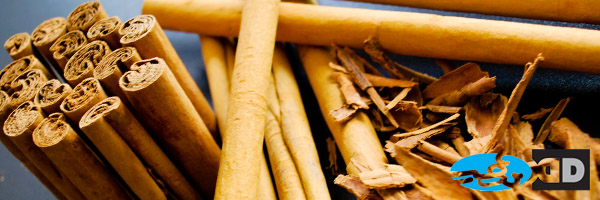
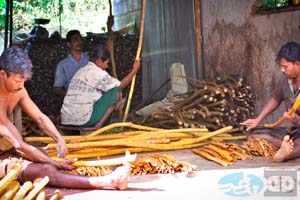
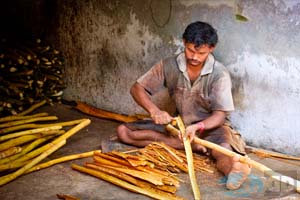
Ceylon Cinnamon(Cinnamomum zeylinicum ) or True Cinnamon is indigenous to Sri Lanka. The dried bark of this perennial evergreen tree belonging to the Lauraceae family is considered a valued commodity because of its unique characteristics that makes it the world’s finest Cinnamon. The branches of this strongly aromatic plant which grows to a height of about 10 – 15m are gathered together for processing. This is done by peeling off the outer bark and then rubbing the branch with a brass rod to loosen the inner bark. It is then rolled into quills, while the outer woody portion is discarded. The hollows formed within the quills are then filled with smaller scrapings of Cinnamon and dried for about 4-7 days before it is processed for export. Today Sri Lanka is known as the world’s leading source of true Cinnamon, producing not only four-fifths of the world output but also the choicest grades.
Uses
Cinnamon is widely used as a condiment and a flavoring agent in cooking and baking while historically Cinnamon played a major role in preserving food, especially meats and has been widely used in Chinese and Ayurvedic medicine. Most often Cinnamon is added to foods item such as salads, confectionaries, beverages, soups, stews and sauces and when immersed in hot water makes a delicious Cinnamon drink. In recent times Cinnamon flavored tea too is increasingly becoming popular. The Cinnamon leaf and bark oils are used to flavor food products, in the perfumery and the pharmaceutical industry. Cinnamon is also known to be used as an insect repellent while the Cinnamon leaf oil is very effective in killing mosquito larvae.
Medicinal and Nutritional properties
Cinnamon has been used for medicinal purposes for centuries and has been known as a healing herb in both Ayurveda and Chinese traditional healing systems as well as in ancient Rome when it was used as a cure for cold and flu and problems of the digestive system. Even today it is thought to relieve congestion., stiff joints and muscles, while boosting brain power, reducing blood clotting and healing the heart and colon. Additionally it is believed to have the ability to control type 2 diabetics and to reduce blood cholesterol levels. Further studies have shown that Cinnamon helps to cure urine tract infections and to fight tooth decay and gum disease.
True Cinnamon Vs Cassia
The term Cinnamon is referred to all the Cinnamon varieties including cassia. However ‘true Cinnamon’ is very much different to cassia and much unique in quality. When comparing the volumes that enter the market, cassia accounts for about 85% market share while True Cinnamon comprises about 15%, where almost all true Cinnamon comes from Sri Lanka. The price of cassia is approximately 1/3 of that of true Cinnamon. Cinnamon differs both physically and chemically to cassia. Followings are some key differences.
Physical Properties
True Cinnamon
- light golden yellow/brown buff colour; slight mottling
- comprised several barks filled with pieces of inner bark and arranged telescopically, placing one bark on the other, rolled like cigar/stuffed
- Bark is thin, Delicate &fragile – easily broken
Cassia
- dark reddish brown colour
- sticks form a “double-scroll”. Formed as a once rolled bark
- Bark is very hard. Not easily broken.
Flavour
True Cinnamon
- Mild, subtle, delicate, flowery, complex; lively, warm & sweet; citrus overtones.
Cassia
- Intense, harsh, simple, sweet, astringent and mucilaginous. Slight bitterness and astringency on the taste (astringency from high tannin content of outer bark). stronger, more intense and often hotter flavor.
Chemical properties
True Cinnamon
- Low to zero coumarin – generally less than 15 mg/kg in the bark; up to 0.3%, rarely 0.7% in the essential oil.
- Up to 2% essential oil
- Bark oil maximum cinnamic aldehyde content 80%; eugenol content 10%
Cassia
- High coumarin content – up to 4400 mg/kg in the bark; up to 11% in the essential oil
- Up to 4% essential oil
- Bark Oil is up to 90% cinnamic aldehyde; only trace amounts of eugenol

HISTORY
Cinnamon was traditionally known to be the most important export of Sri Lanka. However it was not cultivated systematically until the time of colonial rule when the cultivation was shifted from the mountainous regions to the more tropical western and southern coastal belts. It is historically known that the quest Ceylon Cinnamon was one of the key factors that led to explorations to the east in the 15th century and also the reason for many of the wars waged. The reason being that true Cinnamon grew only in Sri Lanka and having access to this wonder produce meant immense power and profits. It was the Portuguese who came to Ceylon in the 15th century when they took control of the spice trade from the Arabs who until then held the Cinnamon monopoly in their hands. Thereafter the Dutch took over the trade after displacing the Portuguese and finally it was the British who controlled the Cinnamon trade when they ruled the country in 1815.
Aenean eu tristique
$160.00
$190.00
Lorem ipsum dolor sit amet, consectetur adipiscing elit. Nam fringilla augue nec est tristique auctor. Donec non est at libero.